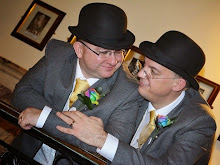
Friday, December 31, 2021
The Avengers vs Doctor Who – A Selection Box
My two favourite TV series, both starring a surprisingly un-macho hero and fabulous women, both kicked off in the early Sixties by Sydney Newman, both among the most iconic and most successful British TV ever made – both exciting, witty, weird and fun.
TL;DR—
If there’s one Avengers episode that’s influenced Doctor Who more than any other, it’s The Cybernauts
Of all the Doctor Who crossover actors, watch out for From Venus With Love and Stay Tuned
Of all the Doctor Who crossover plots, marvel at The Morning After and Man-Eater of Surrey Green
And as I publish this right now, try Look – (Stop Me if You’ve Heard This One) But There Were These Two Fellers… and Dressed to Kill.
But keep reading for why, and for many more!
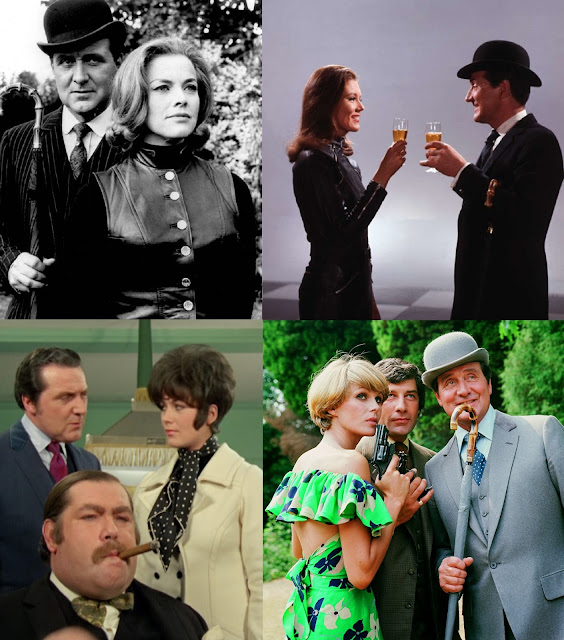
To Begin With… Introducing Doctor Who and The Avengers
The Avengers – A man with a bowler hat and a woman who throws men over her shoulder
Now you can skip to the selections below and start watching, really, but if you want more about one or the other, you could say that both series revolve around a mysterious, flamboyant figure who tempts you from our world into a strange one off to one side, and that neither carry guns or take themselves as seriously as their mission…
Who is the Doctor?
When the current Doctor, Jodie Whittaker, fell to Earth to play the role for the first time, I wrote So Who is The Doctor Anyway? All You Need To Know About Doctor Who, but, again, the TL;DR—
The Doctor is a traveller in time and space who goes anywhere, from Earth’s past, present and future to alien worlds and stranger places still. The Doctor obeys no authority but their own moral sense, uses intelligence rather than violence, and takes joy in taking friends to explore the wonders of the Universe.
Doctor Who began in 1963 and has run ever since in one medium or another, but most prominently on TV through the following three decades and then again ever since 2005 – and back this very Saturday for New Year.
Who are The Avengers?
“The Avengers is about a man in a bowler hat and a woman who flings men over her shoulders.”
…said Patrick Macnee, Steed, and I can’t say better than that, can I? Or as a famous American trailer told us, that extraordinary crimes have to be avenged by agents extraordinary – John Steed, top professional, and his talented amateur partners – The Avengers. Together, they fight diabolical masterminds. Steed is a shady arm’s-length government agent whose gorgeous old-fashioned suits and bowler are almost as wilfully anachronistic as the Doctor, while The Avengers’ own version of time travel is to pair this seemingly conservative continuing lead with a series of intelligent, capable, confident, experienced and physically combative women that broke the TV mould and created the future (and several excellent men, but none so memorable as Steed or The Avengers’ women). Steed is more casually ruthless than the Doctor but just as playful – winning as often as not through outrageous cheating, while the only rule his partners break is gender. A brilliant balance of suspense and silliness, bizarre mysteries, and more than any other crime-fighting / spy-busting duo, they do it for fun. The Avengers is a secret agent series, a comedy-thriller, occasionally sci-fi, riding old-fashioned Britishness and Swinging modernity with equal excitement, its greatest genius to make all the women ahead of their time and the man from a bygone age, a fantasy of Britain with Steed playing on the swings at the heart of Avengerland.
The Avengers began in 1961 and ran through to 1969, along the way becoming the biggest ever hit British show on primetime US TV just as Doctor Who became a hit in dozens of countries, then returned as The New Avengers in the mid-’70s and, like Doctor Who, still lives on in Big Finish productions.
Both much more strange and interesting than almost any other TV series, both sometimes very funny, sometimes sinister, it’s no surprise that The Avengers is the closest show to my heart than any but Doctor Who. Several writers worked on both – and several plots found their way from one series to the other, with cross-fertilisation apparent as early as Sara Kingdom, the Doctor’s high-action, leather-suited companion in The Daleks’ Master Plan – but it’s the actors who really stand out. Avengers Honor Blackman, Diana Rigg, Gareth Hunt, Patrick Newell and Joanna Lumley all had Doctor Who roles too. The Third Doctor, Jon Pertwee, wasn’t just the most Earthbound but had his own The Avengers part, as did the Master, the Rani, and no fewer than three First Doctors (yet not the original). The guest artists appearing across both series are too many to list, but you can find actors from The Avengers and The New Avengers even well into this century’s New Who – most notably Bernard Cribbins and Diana Rigg, but also the likes of Christopher Benjamin, Lindsay Duncan, Roy Marsden and Stephen Moore (and more).
If you’re a Doctor Who fan looking for an excuse to be enticed into The Avengers, here are a few recommendations that stand out. Not necessarily the best, nor all my favourites, nor the most quintessentially The Avengers, but a selection box of flavours you might just recognise…
Doctor Who Stars in The Avengers
From Venus With L💘ve (Mrs Peel – IN COLOR)
The Brigadier, but not the one you’re expecting: he’s Jon Pertwee!
Plus other Doctor Who guest stars from as early as the very first story in 1963 (Derek Newark) to The Eleventh Hour in 2010 (Arthur Cox), and of course The Crimson Horror’s Diana Rigg as Mrs Emma Peel.
This was the first colour episode of The Avengers to be transmitted, and like Doctor Who’s first colour story, Spearhead From Space (itself packed with Avengers crossover actors), this is shot gorgeously all on film, goes down to Earth but not quite the world as we know it as our heroes – the eccentric dandy in the vintage car and the fantastically overqualified, caustically sharp-witted scientifically accomplished woman working for a mysterious secret agency – investigate an alien invasion…
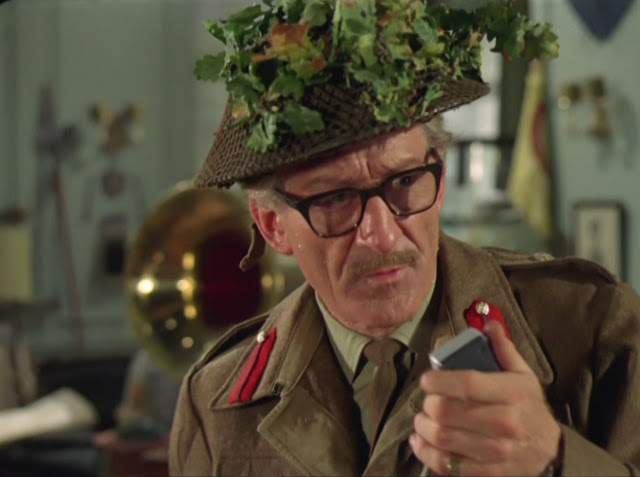
The Eagle’s Nest (The New Avengers)
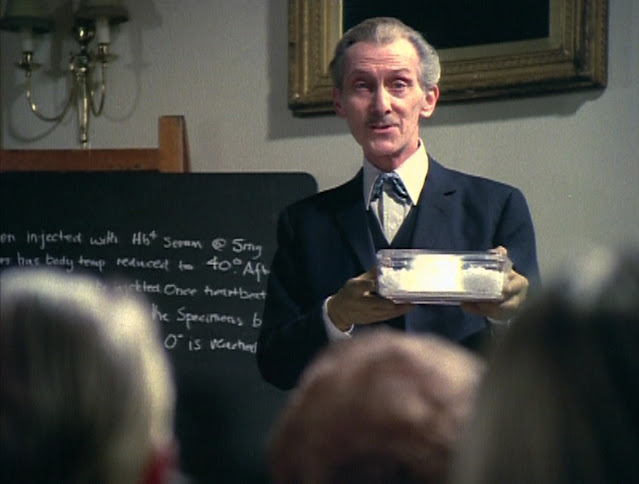
In which movie Dr. Who Peter Cushing is delightful, in almost the same moustache!
He’s so much nicer than his Frankenstein, despite this role having crossover appeal to that too (and still more to Doctor Who – The Brain of Morbius, starring multiple-Avengers’ Philip Madoc).
This episode introduces Joanna Lumley and Gareth Hunt as The New Avengers, and for Doctor Who side-leads also gives us a minor role for the lovely Trevor Baxter, famously Professor George Litefoot. Slightly disappointingly, Litefoot gets an unrewarding role in a good episode, while Jago has a rewarding role in weak ones: Trevor Baxter’s partner in Jago & Litefoot, Christopher Benjamin, is probably the best thing in three different indifferent Avengers episodes, of which the best is probably Split! (which also stars the superb Julian Glover).
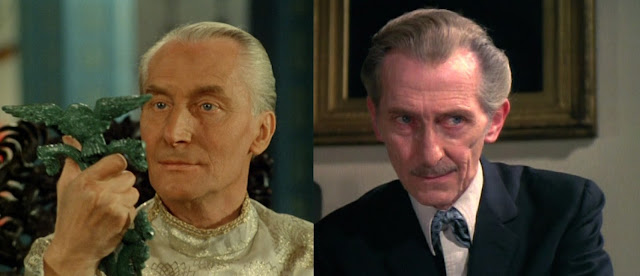
Return of the Cybernauts (Mrs Peel, Colour)
In which movie Dr. Who Peter Cushing is not delightful at all, but full of sinister charm.
With Frederick Jaeger, Fulton Mackay and of course the Cybernauts, of which more later.
Legacy of Death (Tara King)
Among many villains (and several Doctor Who guest actors) one-time third First Doctor Richard Hurndall.
This one’s a parody of The Maltese Falcon written by Dalek devisor Terry Nation (with a hint of Davros). He also sends up his own Daleks, not entirely successfully, in Thingumajig, while his Invasion of the Earthmen has an absurdly ambitious satirical concept not done all that well but does manage to anticipate The Sontaran Stratagem and even (briefly) the Sontaran design. But if you’re looking for a really excellent Terry Nation The Avengers, go for Take Me To Your Leader – despite the title, that isn’t very Doctor Who at all, but it is fast, stylish and hugely entertaining.
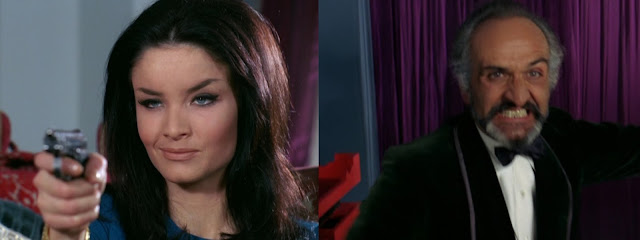
Stay Tuned (Tara King)
The story looks like a time loop… Could it be something to do with two evil Time Lords brought together (if only briefly sharing the camera) long before The Mark of the Rani – the Master and the Rani, Roger Delgado and Kate O’Mara!
Look – (Stop Me if You’ve Heard This One) But There Were These Two Fellers… (Tara King)
The wonderful Bernard Cribbins! He’s just turned 93 this week, and you can see this one on ITV4 on Monday 3rd January at 8.30am (he’s also in The Girl From Auntie).
But that’s not all – this outstandingly fun episode is written by Doctor Who writer Dennis Spooner and has several other crossovers from John Woodvine to John Cleese.

Dressed to Kill – Anneke Wills & Steed in fancy dress; Look – (Stop Me…) – Bernard Cribbins & Steed in a paper-strewn mess
Dressed to Kill (Cathy Gale)
Another topical episode as I write: this is a tale of the New Year, so one for tonight!
And among several fabulous guest stars is Doctor Who companion-to-be Anneke Wills.
Mission… Highly Improbable (Mrs Peel, Colour)
Not quite the Brigadier but a similar sort of role for Nicholas Courtney, with bonus Kevin Stoney – in between the two of them being on opposite sides in Doctor Who’s The Daleks’ Master Plan and The Invasion (though in the end they’re given quite small parts).
The Avengers Plots in Doctor Who
The Morning After (Tara King, though in this Steed’s mostly paired with Peter Barkworth)
This terrific, eerie, stylish adventure is immediately recognisable as a much crisper prototype of the more political Invasion of the Dinosaurs, though in this one the big, roaring monster is BRIAN BLESSED!
The Mauritius Penny (Cathy Gale)
Written by Doctor Who authors-to-be Malcolm Hulke & Terrance Dicks, in which a tiny thing spirals hugely out of control and eventually into a plot that echoes later in Doctor Who – Robot. Though it gets even bigger there.
Man-Eater of Surrey Green (Mrs Peel, B/W)
The most infamous of all, as most of this plot sprouts again in The Seeds of Doom. Although it’s also fair to say that both borrow quite a bit from Quatermass…
Doctor Who Cameos in The Avengers
Death at Bargain Prices (Mrs Peel, B/W)
Featuring André Morell (more bonus Quatermass), T.P. McKenna, John Cater and Peter Howell, but this exciting adventure with a department store most strikingly sees Diana Rigg arranging toy Daleks.
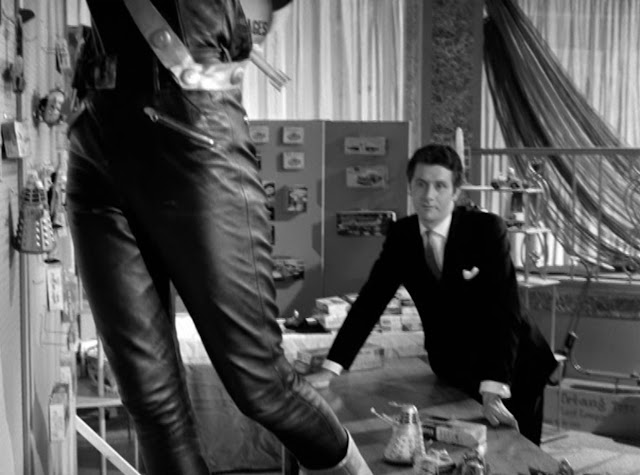
I know what the male gaze wants… Daleks. – Death at Bargain Prices
Target! (The New Avengers)
Gasp at repeated cameos for a shockingly abused TARDIS in The New Avengers’ most iconic (if not most logical) episode. Featuring many familiar faces and the worst Doctor in the world (medically), Target! is written by former Doctor Who Script Editor Dennis Spooner and is almost a doppelgänger for the previous year’s Doctor Who – The Android Invasion, written by former The Avengers Script Editor Terry Nation. Even the very first episode of The Avengers, Hot Snow, has a pre-Doctor Who police box in a rainy film insert in its surviving quarter-hour.
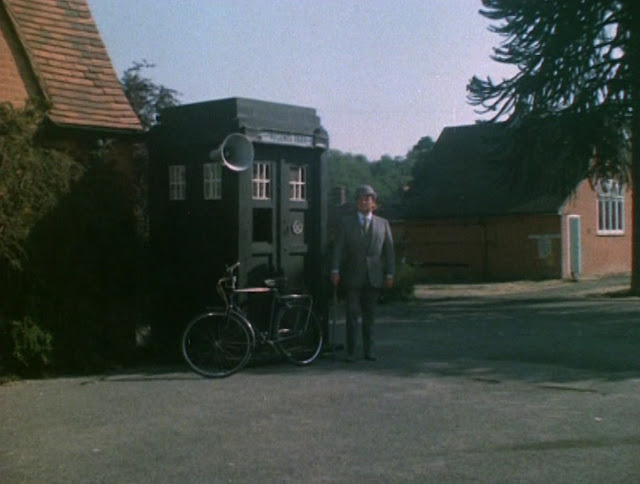
Target! – a police box stands on a village corner, John Steed at its side.
The House That Jack Built (Mrs Peel, B/W)
Before the police box exterior in Target!, an old-fashioned exterior hides weird ultra-modern corridors with what seems to be a super-sci-fi central control console. If the titular House That Jack Built isn’t a TARDIS… I like to imagine the villainous Professor Keller let the Master have his identity for The Mind of Evil, and the Master let him borrow his TARDIS to get at Mrs Peel in return. If ever The Avengers consciously borrowed from Doctor Who, this is it…
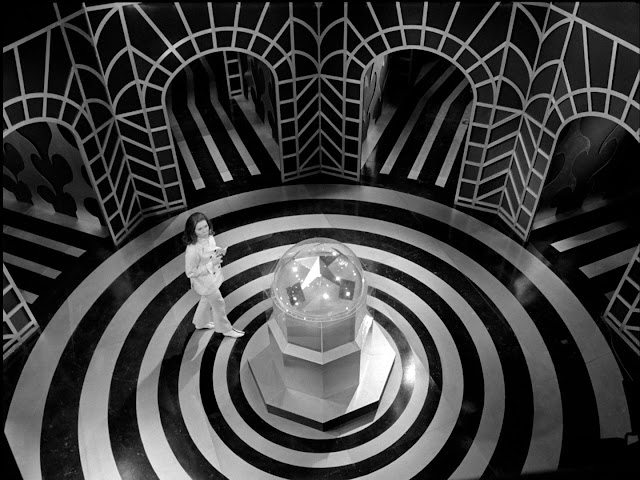
An Eccentric Array of Doctor Who-interest The Avengers Episodes
The Cybernauts (Mrs Peel, B/W)
…While this most sci-fi of all The Avengers conspicuously influences Doctor Who from the obvious Cyber-monsters through The Web of Fear and Spearhead From Space to Terror of the Zygons, with an abundance of familiar actors as a bonus (Michael Gough, Frederick Jaeger, Bernard Horsfall, Burt Kwouk, John Hollis, John Franklyn-Robbins…).

The Cybernauts – a blank-faced metal Cybernaut (brilliantly disguised in dark glasses, coat and hat). Smashing!
The Positive Negative Man (Mrs Peel, Colour)
It’s not so much the plot here that turns up in Doctor Who as many individual images; with its mysterious stalking figure that kills with one touch, or burning files in a safe, not to mention people being ‘magnetised’ to an antique car, I wonder who was watching a repeat of this one evening while working on The Ambassadors of Death.
The Gravediggers (Mrs Peel, B/W)
A Doctor Who writer in Malcolm Hulke and not just several Doctor Who guest stars but even two from half a century later in New Who (Diana Rigg and Steven Berkoff). Not given much to do here but a particular favourite of mine, this is The Avengers with the fabulous Wanda Ventham, who guest-starred in Doctor Who stories in 1967, 1977 and 1987, and I have to say New Who seriously missed out by not casting her in 2007 and 2017 too.
The Wringer (Cathy Gale)
See Doctor Who producer-director-to-be Barry Letts when still an actor! Plus, amid several Who actors, mind-melting Terence Lodge makes me feel this is a little like The Macra Terror.
Quick-Quick Slow Death (Mrs Peel, B/W)
Strictly Avengers by Robert Banks Stewart, who later wrote two of the most Avengers-adjacent Doctor Who adventures in Terror of the Zygons and The Seeds of Doom.
The Town of No Return (Mrs Peel, B/W)
Introducing Diana Rigg, whose Doctor Who – The Crimson Horror features an explicit plot lift from this, and for me the first seven minutes of this are the ideal introduction to The Avengers. Plus the first of many appearances by Patrick Newell.
Escape in Time (Mrs Peel, Colour)
And finally – ish – not just guest-starring Geoffrey Bayldon, on audio the fourth First Doctor (or minus-oneth, or… well, another one, anyway), not just one of my favourite Avengers guest villains in his biggest role (Peter Bowles, who crosses over to The Sarah Jane Adventures many years later, just as Murray Melvin goes from the very first Avengers episode to an enigmatic enemy in Torchwood), not just one of the most vividly enjoyable escapades in Avengerland, but the one with time travel!
Or is it?
Though these are the ones that most stand out for me, you can find Doctor Who connections in dozens more of The Avengers. The Curious Case of the Countless Clues stars Edward de Souza, the only TV Doctor Who lead in a story with no Doctor at all; All Done With Mirrors and Angels of Death feature Dinsdale Landen, but in which is he as villainous as Fenric? Fog is as mock-Victoriana as The Talons of Weng-Chiang, even down to Patsy Smart’s crumbly Cockney, while The Enemy of the World borrows wholesale from The Living Dead. And I’ve somehow not paid enough attention to some of my very favourite Doctor Who villains who cross over as some of my very favourite The Avengers guest stars (and villains – or are they?), so three each for:
- Julian Glover – Pandora, The Living Dead, Two’s A Crowd
- Philip Madoc – My Wildest Dream, The Decapod, Death of a Batman
- Peter Jeffrey – The Joker, Game, House of Cards
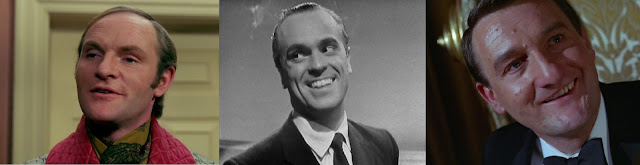
The Three Villains (or are they?)
Or… Doctor Who Stories to intrigue The Avengers Viewer
Spearhead From Space (Third Doctor)
I’m mainly assuming all this is most likely to be read by people more familiar with Doctor Who than The Avengers, but for the other way round, this is a great place to start. As I said above, this is about as The Avengers (and as Quatermass) as Doctor Who gets, with crossover actors, a flamboyant Doctor and a brilliant woman lead, and where the sinister countryside should have a sign up saying ‘Twinned with [From] Venus [With Love]’.
The Seeds of Doom + City of Death (Fourth Doctor)
The Seeds of Doom is the most infamous homage, with a mean green* menace from outer space, a millionaire plant obsessive with a murderous chauffeur, and even a scene-stealingly fabulous eccentric elderly lady. But I’m going to go against the tide and say that while it may be very Avengers on paper (from Avengers writer Robert Banks Stewart), the stylish, powerful direction means it doesn’t feel like The Avengers at all. It’s the closest Doctor Who comes to The Sweeney. So I’d pair this with its opposite: between them brutal The Seeds of Doom and witty, arch City of Death are the tonal extremes of Tom Baker’s Doctor, and while the plot has little of The Avengers, City of Death has an insouciantly Avengers mood and even Villainous Julian Glover.
*Technically black and white in The Avengers
The Web of Fear + The Mind Robber (Second Doctor)
Similarly, take one story with terrific filming and robots exchanging great, smashing blows from The Cybernauts (and guest-starring part-time Avenger Jon Rollason), add another with fabulous Op-art sets and surrealism (featuring the most Avengers fight for any companion), to find Doctor Who being quite Avengers-y between them.
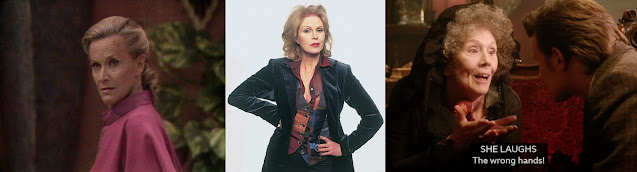
The Who Avengers!
The Crimson Horror (Eleventh Doctor)
Villainous Diana Rigg! Who could ask for more? With a diabolically The Avengers sort of plan a hundred years early and a fake-out with a gramophone borrowed from her first The Avengers episode.
The Trial of a Time Lord – Terror of the Vervoids (Sixth Doctor)
Guest-starring Honor Blackman as Professor Lasky, almost as intelligent as Mrs Gale (though to be frank both her judgment and her outfits are far better in The Avengers).
Planet of the Spiders (Third Doctor)
Gareth Hunt as a pre-The New Avengers bit of rough. Also starring (in thrilling stunt chases) Jon Pertwee from The Avengers – From Venus With Love.
The Android Invasion (Fourth Doctor)
Terry Nation writes by far his most The Avengers Doctor Who script in tone, with a mysterious village and the Brigadier replaced by Mother (Patrick Newell). And yet a completely different story is titled The Androids of Tara (though that one’s much better, even more entertaining, and stars Villainous Peter Jeffrey).
Robot (Fourth Doctor)
Terrance Dicks borrows just some of his The Avengers story The Mauritius Penny, the Doctor and Sarah Jane are as witty and wonderful a pair as you could wish for, and Harry disguises himself as Steed. And both Steed and the Doctor formatively fight fascists.
The Stones of Blood (Fourth Doctor)
Though Honor Blackman turned down a role in this one, we still have fabulous women, including an icily amazing Time Lady who’s the Doctor’s equal, and like so many Avengers it could be subtitled ‘Escape From the Country’ (the villain has chosen to escape to the countryside, which just proves it).
The Curse of Fatal Death (The Many Doctors)
A Comic Relief spectacular in which the ultimate Doctor is Joanna Lumley.
Pick one, dive in, and enjoy!
This was partially inspired by the lovely Roy Gill’s #AvengersWho Twitter thread at the beginning of the year, mashing up The Avengers / Doctor Who story titles. I particularly enjoyed his ‘Castle De’Ath To The Daleks’ and ‘The Hexapod’, Elliot Chapman’s ‘Dial a Deadly Assassin’ and Brendan Jones’ outstanding ‘You Have Just Been Pulverised Into Fragments And Sent Floating Into Space And In My Book That’s Murdered’. I added ‘Doctor Who Was That Woman I Saw You With’ and ‘Rise of the Cybernauts / The Age of Steed’, but then took eleven months to think about this more detailed contribution.
Update: Daniel Blythe brilliantly calls my attention to a fourth First Doctor (technically the third?) in The Avengers, as Frederick Jaeger plays a character who becomes the Doctor for a time in Doctor Who – The Savages.
Labels: Doctor Who, Honor Blackman, Jago & Litefoot, Joanna Lumley, Julian Glover, Peter Jeffrey, Philip Madoc, The Avengers, The New Avengers


Monday, September 27, 2021
Labour’s Ten Holy Rules of Political Parties
The Tory Government is in a catastrophic mess, their incompetence, callousness and obsessive Brexit all responsible for such food and fuel shortages that they’re temporarily retreating even on their one core ‘hating foreigners’ policy.
Instead of Labour calling for practical solutions – rejoin the Single Market – the Labour Conference turns its fire on itself to fight its next Leadership election, while Labour MPs boast of the “hard truth” that they were happiest when losing their worst election since 1935.
Well, of course. Labour is never happier than when the Tories are in power: Labour need make no decisions, take no responsibility and have no message beyond ‘We’re s—t, and we know we are, but oooohh! The Tories! Scary!’ so they can get on with fighting any party but the Tories in the name of purity.
In May I wrote a Twitter thread on Labour’s attitude to political parties. Back then, I was inspired by Labour’s actions after losing votes and seats in elections. Labour in London – where Tories, Greens and Lib Dems on the London Assembly proposed sharing chairs between all four parties; Labour demanded all or nothing, then walked out, so the others shared them out. Labour, having gone off in a strop, spins this as a “coalition” despite Labour’s Mayor having the administration and the Assembly chairs being there only to hold the Mayor to account. Meanwhile, Labour in Stockport – where they lost a seat in this year’s local elections, so the Lib Dems are now the largest party on the Council? Stockport Labour and the Conservatives did an actual deal together to keep Labour in power-sharing with Tories. So…
For anyone confused about Labour’s attitude to any political party, remember Labour’s 10 Holy Rules:
1) The Tories are the ultimate evil, nothing could possibly be worse, any voters voting for them or parties talking to them are forever damned, we don’t want your votes!
2) We can’t understand why you don’t vote for us! Why don’t you just vote Tory! That’ll scare you off voting Tory.
3) The Labour Party is always right, the fountain of all holy goodness.
4) Not that bit of the Labour Party, they’re worse than Tories.
5) No, you can’t tell which bit of the Labour Party is holy by checking who’s racist / sexist / homophobic / transphobic. Holiness is found not in deeds but revealed truth.
6) Only we can reveal the truth (but don’t ask us to explain, or we might call you a Tory)!
7) Election day: Lib Dems / Greens are just Tories, their votes are Tory, vote for them and you’re a Tory, don’t vote Tory, any party but Labour is a Tory!
8) Day after election: Labour technically won because Lib Dems / Greens are really Labour votes and they count for us.
9) Labour should go into coalition with the Tories (e.g. Stockport Council) to keep out Lib Dems or Greens.
10) Only by embracing Tory Brexit, agreeing with all Tory policies and wiping out all parties that are not Tory can Labour overcome the Tories. Disagree? You’re a Tory!
Bonus Labour fact: on this day in 1999, the Labour Government was defeated in the courts after fighting for two and a half years to keep the ban on bi and gay people serving in the armed forces. Having spent millions of pounds defending discrimination, Labour spin then claimed the credit for dropping the ban only after being forced to stop it by the courts. To this day they pretend they were against inequality when the reality is they fought to protect it. Shameless!
Extra Bonus Labour fact: later in the afternoon actually today! Labour Conference rejects proportional representation. As always, Labour will go to any length to protect the Tories having absolute power (but with the chance of Labour getting absolute power once every thirty years) if the alternative is Labour sharing any power with any party that isn’t Labour-Tory.
Labels: Conservatives, Labour
Tuesday, September 14, 2021
My Impassioned Speech on Equal Marriage (and more)
LGBT+ rights are deeply personal to me and at the heart of Liberal Democrat values – but sometimes we have to stand up for them even in the Lib Dems. With another Lib Dem Conference looming, my Equal Marriage speech two years ago today was one of the most nerve-wracking I’ve ever delivered – though also one of my best. I had to stand up to a then-MP and a former Leader, because many people knew someone had to but no-one else was doing it (I’ve even drawn out lessons from two former Leaders at the end. Don’t have nightmares).

My Speech on Equal Marriage, Liberal Democrat Conference, Bournemouth, 14th September 2019
Next month is my fifth wedding anniversary.
But my husband Richard and I have been together twenty-five years.
The wait wasn’t because we’re really traditional and wanted a really long engagement.
We had to wait for the Liberal Democrats in Government to change the law before we could get married on our twentieth anniversary.
Thank you.
Liberal Democrats have always had the best policy of any party on LGBT+ issues.
But it’s not just the policies and campaigning issues.
For me it’s personal.
We got married – but many people still can’t.
We got married – that’s why I can’t stand by and say, ‘I’m all right, Jac, never mind the rest of you.’
I must stand up. We must stand up.
Jo Swinson talked about love in her victory speech as Leader.
This is a simple choice: love or hate.
Liberal Democrats are about love and liberty.
Now, I take it personally when people tell me I shouldn’t have the same rights – my marriage matters!
Is it a matter of conscience? Yes! For the people getting married!
But if you want to bully people, to enforce your prejudices on people, to stop people making their own decisions…?
That’s not conscience – it’s control!
Everything in this motion comes back to the same founding principle: people’s right to control their own lives.
But it’s not just about policy. It’s about the face that the party shows.
I welcome people joining us from other parties. Some will be fully-formed Liberals, and some you might have to give more Leeway to.
Like children raised by wolves, you might not expect them to have perfect table manners, but we should expect all our MPs to say without qualification, ‘Biting people to death is wrong’, and if you’re in doubt, ask someone with scars, don’t say, ‘No-one’s ever tried to bite my leg off, so it’s just a point of view if they bite you.’
We should expect all our MPs to be whipped to stand up and not make excuses for homophobia.
Phillip Lee: I know you’re married. I hope you’re both very happy. Was it a long engagement?
We wrecked our last General Election campaign because we compromised – one person compromised – on homophobia.
Listen, all our MPs: if you don’t want to wreck the next one, it’s not just about the policy.
To put it in language at least two of our MPs will need to understand:
You may try to get into Parliament with good policies, but without faith you are nothing.
Surprisingly Good Reviews
Many Lib Dems agreed with this speech – many laughed, many clapped, Caron Lindsay was particularly kind on Twitter – which helped balance the usual line of the great and good saying How Very Dare You. But just this once, I did get some very good reviews from the New Statesman. Stephen Bush cited me in his write-up of the debate:
“In a speech that received loud applause from the floor, Alex Wilcock, a Liberal Democrat activist, spoke about the 20 years he had to wait to marry his partner, and asked Lee if his marriage had a similarly “long engagement”. It was Wilcock’s speech that also got to the heart of the Liberal Democrats’ unease over Lee’s admission: the party’s defence and toleration of their then-leader, Tim Farron, and his record on equal rights, and the price it paid for that at the 2017 election.”
But my cockles were most warmed by him and Alibhe Rea on The New Statesman Podcast – Lib Syncing, 19th September 2019.
Stephen Bush:
“For me the best speech, actually, of the Conference, and I also think probably one of the best speeches I have seen in party conferences all told, was from a man called Alex Wilcock, who spoke about his own marriage, the very long engagement and the fact that same-sex marriage was illegal for so long, and basically challenged both Phillip Lee and the party for kind of turning a blind eye to some of the aspects of his voting record.”
Alibhe Rea:
“Yeah, it was pretty powerful, that they had been engaged for twenty years and unable to marry, and then the concluding line of his speech was something like, you know, ‘Phillip Lee, I gather you’re married, I hope you’re happy – was it a long engagement?’ It was really quite stirring in the context, and he was just a very good speaker. He’d sort of circled around and alluded to it for quite a while, and then arrived at that conclusion.”
Which is probably the best review I’ve ever had in the press (at least since the Daily Mail’s double-page-spread hit-job back in 1994, which was flattering in quite a different way).

Why I Made This Speech
I wasn’t going to make that speech. I wasn’t going to speak at all. If you want to make a speech in a physical Lib Dem Conference debate – it’s even less flexible in the current online Conferences – you need to put a card in saying roughly what you mean to say well in advance of a popular debate, usually at least the day before. I hadn’t, and had no intention to. But there had been so many hurt people around – not least friends who’d resigned from the party over its welcoming in an MP who saw us as Hell-spawned inferior life forms and wanting to tear out our hard-won rights. I’d prefer a sinner to repent, I’d like everyone to get along, but confronted with the choice between an unrepentant bully and people whose values actually belonged in the Liberal Democrats, there was no way not to pick a side. I woke at 4am that Saturday, stressed and depressed, massively wound up, and could not get back to sleep. So I did the obvious thing: I started thinking of a speech. Amazingly, I was in the Conference hall by 9.30am and put in a card (after Tweeting an obscure declaration of intent which nobody else would get but to stiffen my sinews). More amazingly still, I was called to speak.
I’d been scribbling thoughts, desperate to sort out what I thought at all, how much of it I should say, what tone I should take, and how on earth I might fit any of it into three minutes, which is a very short time indeed once you’re up on stage and gives no room for waffle (in the end, I was so focused on getting to the point that I ran under time). I still have the several sheets of paper where I can see my thoughts take shape – and how much was still unformed by the time the debate began. Unusually, I hadn’t decided how to end it even as I walked onto the platform and opened my mouth. But before I wrote anything else, I had circled to one side at the top, next to where I had to put the opening lines: “Serious and funny!”
A debate speech should have a point – you want to swing people’s votes with you. Sometimes I’ll wing it as I go along, but there are always two parts I need to prepare: the opening, because that gets people listening to you; the closing, because that gets people applauding. The finest arguments have been lost when people are still nattering from the last one because they don’t notice you’ve started or when stopped in mid-flow as your time runs out and the mike’s cut off. I realised both very early, but over the years I’ve set a second aim for the opening line that’s more difficult: it’s also to get people on your side. Whether it’s a joke, a self-deprecating moment or just saying hello, an effective speech begins by getting people to like you. The previous year, I’d made a blistering speech against a policy paper that hand-wringingly appeased bigots over immigration. It was one of my best speeches, focused, incisive, impassioned, but it had an opening like chucking a brick through a window, and while that got people’s attention, I don’t think it got anyone on my side. This time I might have to be even more combative – not attacking a paper, but possibly attacking MPs in person. Fortunately, this speech was personal and a personal opening came naturally, even with a funny bit and an opportunity (heartfelt as it was) to butter Conference up.
The Equal Marriage motion not only celebrated the Liberal Democrats’ achievement of making marriage legal at last for same-sex couples, but recognised that equal marriage is still some way off and set out how to get there – in Northern Ireland, for humanists, removing the hugely unfair spousal veto for trans people – and with speeches overwhelmingly in favour was passed, too, by an overwhelming vote in favour as Lib Dem policy.
Several excellent speeches before mine dealt with those issues for marriage directly, with the rise in homophobic attacks, with Labour MPs wanting a new Section 28, with daily virulent press transphobia – I was crossing off bullet points I’d scribbled haphazardly across my notes, helpful in terms of keeping better to time by not repeating what everyone else was saying, but with stress rising as I listened out for what everyone else was leaving unsaid. MPs and former MPs I admire paid loving praise to people who’d left the party because of— What? Our party was the best on LGBT+ values, and was getting better in this very debate, and yet for some reason that dared not speak its name people were loudly hoping that one day leading LGBT+ activists might somehow find their way back. Many in the hall must have wondered, had they accidentally slipped through into some parallel dimension and were merely lost, because surely nothing about our party was explaining it? I very much did not want to give the speech I could see in a choose-your-own-adventure set of variably hard-hitting ideas scribbled in question marks, but by the time I was called to speak (and for the rest of the debate) no-one else had said a word, and someone had to.
For that Conference, the number of Lib Dem MPs suddenly almost doubled: some defectors I was enthusiastic about; some seemed OK; and then there was one. In June 2019 I had written not a blog post but a Twitter thread as speculation about defectors rose: my instinct was to welcome everyone who chose to side with us. I was thinking aloud on Twitter, but I still – mostly – agree with myself. Yet there are always caveats… But it was by being welcoming, bold and Liberal that we attracted so many people who used to vote for other parties. Being open doesn’t mean watering down what we stand for – if we don’t stand for anything, no-one would make the leap anyway. Though I can’t help thinking that, as one of the Leadership’s more appealing themes at the time was that we were leading a wider Liberal movement, it might have saved a lot of heartache if we’d persuaded a defector standing with us on the big issue but clearly a git on others to caucus with the Liberal Democrats in Parliament as part of a wider Liberal movement and not actually join a party whose values he does not share (that nobody thought of it after years of the party faffing about with supporters’ schemes…). I didn’t actually say that because there wasn’t room for procedural rumination, but despite appearances I have never given a speech in which I was more thinking aloud.
Today I sum up Lib Dem values in three words: Freedom, Fairness, Future. I’ve been writing and speaking about the first two, intertwined, since the early ’90s: that was when I identified them as “Love and Liberty” in a long philosophical pamphlet, and carried that on to this blog. But “Love” isn’t a word politicians are often bold enough to claim, so I was delighted when Jo Swinson did that Summer, and I seized on it. Not just because I agreed with her and applauded her speech, but because if you’re about to go in with both barrels it always helps to call the Leader on your side. But that and my funny opening had a point: this is not ‘a point of view’. This is not just a debate. This is something that is crucial to real people’s lives, and no Liberal should be hoarding rights that they deny to others.
There was a moment where I nearly lost it. As I declaimed, “That’s not conscience – it’s control!” the last word surged up in a growl that almost frightened me: I’d never heard that tone from myself in a speech before and I realised with a shock that I was seconds from just shouting in righteous anger. It doesn’t seem as visible as it felt, but I pushed myself down hard inside, because I knew that I was at the pivot to the dangerous bit of the speech and, suddenly, I could so easily lose control. I forced myself to sound more at ease, to slip in a cutting pun, a stealth Doctor Who reference and a breezily insulting put-down. But as there’s a storm of applause, I wince now seeing the curt gesture to cut it, harsher than I’ve ever been in a speech, as I’m fighting not to snap. And then I say the line that I remember most vividly: “Was it a long engagement?” And it’s only three seconds before I dive on, but after the laughs and applause the deathly shocked silence at that picking up Chekhov’s punchline from earlier and making it a punch in the face felt like an eternity, and inside I was panicking that I’d blown it.
So as I went into the close, knowing I was going to finish with a mangled flourish from my religious upbringing – that you may try to get into heaven with good works, but without faith you are nothing – wielding it as a righteous flaming sword against two theocratic bigots, but not knowing how I was supposed to get there, with several partial versions scribbled in front of me and none I was happy with, and at the last moment somehow navigated between the cop-out of sticking only to Phillip Lee and full-on naming and shaming Tim Farron. I glanced at the scrawl of lines hoping we would pass the policy then warning that most people would never hear about it, while many voters would hear if so-called Liberal MPs lust to control others and claim their religion says my twenty-five years is too short a wait; or reminding the lucky few Lib Dem MPs elected in that disastrous General Election of the cost of weakly suggesting homophobia is just a point of view. But I swerved away from going full Old Testament thunder because I might never stop, or explode in sheer incandescent rage. I feared I’d already lost the hall but I was committed to saying something – in the end, my more tightly controlled ferocity still got the point across and the thunder was left to the applause.
Where Nick Clegg Went Wrong
I thought hard about whether to say any of this, after leaving it unsaid in 2019 – both in a speech that in the end confronted what everyone knew in the least confrontational way I could bring myself to, and after holding back from saying it at far greater length earlier that year. It isn’t uplifting, so you may wish just to stop here. But I’ve made myself look in order to learn.
During the 2019 Liberal Democrat Leadership election I wrote – most of – an article assessing the three immediately previous Leaders, and lessons to be learned. Though I wrote at length about the positives for each before blasting their big disasters, I never published it. What I had to say about Nick felt too much like old wounds, what I had to say about Tim Farron was still too raw and hurt and blisteringly angry, and I never quite finished writing about Vince, as just too meh (though in a late surprise entry since he’s now topped the ‘Most Problematic Former Lib Dem Leader’ chart. I wish he hadn’t). I’m not going to publish all that now. But it’s worth summarising the crucial lessons: not just when two Leaders f—ed up, which everyone knows, but why those particular f—k ups were so deadly. I’m not going to assess the whole Coalition – though Richard and I did say thank you for our marriage on our (twenty-years-and-) six-month anniversary, without which we’d still be waiting.
Here goes, though. “Tuition fees” was engraved on every Lib Dem heart and every anti-Lib Dem attack leaflet. The biggest, most catastrophic, monumental political misjudgement of the Lib Dems in Coalition. Yes, we all know this. But steel yourself and look at just why this was so destructive. First and foremost, for the Lib Dems (and for Nick Clegg personally), education is an absolute, passionate priority. It’s at the centre of enabling everyone to have the opportunity to realise their potential, not just a policy but at the heart of our philosophy. And in Coalition government, we championed education; we protected the schools budget from cuts and introduced the pupil premium, so schools got more money to help teach poorer kids. But every single time any Lib Dem mentions it to this day, what does every voter think? ‘But tuition fees.’ F—k. Breaking the promise was bad, but breaking the heart of our values was catastrophic. And from naked political nous, university towns and higher-educated voters had become the hard-earned most likely to vote Lib Dem, and the tuition fees betrayal kicked them in the face. It’s hard to think of a more laser-guided missile to the Lib Dem vote.
Some More of Tim Farron’s Greatest Mistakes
Which brings me to Tim Farron. The 2015 Leadership election was blighted in two ways: not only did we have practically no MPs left to choose from, but in hindsight the two contenders were summed up by Yes Minister:
“If Eric gets it, we’ll have a split in the Party in three months. If it’s Duncan – we’ll have one in three weeks.”
Eurosceptic Norman Lamb would have been an utterly catastrophic Lib Dem Leader for Brexit. Tim Farron made the critical choice that we would stay fighting as the party of Remain, a brave, principled decision trying to save Britain’s future that also enabled the Lib Dems to survive the near-extinction event preceding Farron’s Leadership and then the near-extinction event precipitated by Farron’s Leadership. But then, obviously, he went and proved that while it’s hard to think of a more laser-guided missile to the Lib Dem vote than tuition fees, it could still be done. I’m trying to strike an ironic tone, but I’ve cut my next four paragraphs from 2019 because they’re unlikely to do anyone much good, and certainly I felt the fury, misery and betrayal rising just re-reading them. Plus there aren’t enough em dashes to cover all the swearing. Every single day of that blighted election I defended him because I thought I knew him, as furious and hurt and betrayed LGBT+ people said, ‘How can you do this to us?’ But Farron didn’t just destroy the LGBT vote for the Lib Dems, much as Nick didn’t just hammer the student vote. This was about the sort of party we are and the sort of people who might vote for us. Think about the sort of voters who are likely to listen to the Lib Dems. Even if they don’t mention it on the doorstep, how are they going to react to the only thing they hear from the Lib Dems, day in, day out, being that their Leader doesn’t like the gays? A more perfectly targeted voter-seeking missile even than tuition fees – not even the excuse that the money was too tight, not even the excuse that we couldn’t get another party to accept it, but simply because the Leader we chose had chosen to be a bigot. Name me anything a Liberal Leader could possibly do more effectively to alienate Liberal-minded voters. They recoiled en masse. In the year of the universally hopeless leaders, to be more of a voter turn-off than disintegrating robot Theresa May and a UKIP nonentity? The 2017 Lib Dem Leader was sheer electoral poison – delivering an even lower vote than 2015’s collapse, the worst share of the vote for British Liberalism since the 1950s – and, as votes had to go somewhere, if you wonder how on Earth people once saw any hope in Brexit’s Best Mate Jeremy Corbyn, Tim Farron was his biggest asset.
I had known and liked both Nick Clegg and Tim Farron since long before they became Leader. I felt for both of them… But I admit one I find easier to forgive for their worst calls when leading the Liberal Democrats. It’s an appallingly hard job and I wouldn’t wish it on anyone, but it’s also hard not to want to tell anyone doing it: if you must f—k up, can you at least think about what’s deepest in our values and what’s most important to our voters, and try to f—k up at the furthest-away political point from both?
Labels: Gay, LGBT, Lib Dems Believe, Liberal Democrat Conferences, Liberal Democrat Leadership, Liberal Democrats, Richard, Speeches
Monday, June 28, 2021
Time and the Rani Vs Bananarama
“I have the Loyhargil – nothing can stop me now!”
Celebrating today’s release of Doctor Who: The Collection – Season 24 Blu-ray, I’ve been transported back to the time with a tune in my head that just won’t stop: Nathan Jones by Bananarama, with a very different chorus.
 |
| Doctor Who: The Collection – Season 24 Blu-ray cover: the Doctor (Sylvester McCoy), in cream jacket and hat, bearing spoons, framing the Rani and a set of monsters |
I’ve been trying to write something very serious and meaningful that ties in to the far end of Sylv as the Doctor. That’s grinding very slowly, so here’s something very silly and shallow tying in to the beginning of Sylv as the Doctor instead.
 |
| “Leave the Girl – It’s the Man I Want!” Season 24 titles triumphant in 67 varieties by @paulxdesign (badgewolf on Redbubble) |
Subtitle for missing graphic: In the absence of any skill with Photoshop, imagine I’ve done a Bananarama single with the heads replaced by Mary Tamm, Lalla Ward and Kate O’Mara. I haven’t, but you can imagine it.
 |
| Nathan Jones single, back cover – Bananarama strike an X-pose! Keren Woodward and Sara Dallin (heads up) and, in the middle, the other one (Jacquie O'Sullivan, head down) |
Play loud!
Time and the Rani By Romanabarmikarma
You sacked your man, as I recall
When ratings slowly down they fall
You said that you’d be back someday to relaunch fine
And all you needed was just a little Time [Lord]
Woah, Summer’s passed, you’re back this Fall
Time and the Rani [Oh Heaven help me] – exploding balls!
Doctor Who – at last you’re back on
Doctor Who – at last you’re back on
If a fanboy could die of fear
Colin cancelled, a well of tears
It seems that you’re folding – where’s the encore?
Was there no room on the box for you no more?
Woah! Sylv is cast, and I’m enthralled
(Though against Corrie [How very sorry] you can’t walk tall)
Doctor Who – at last you’re back on
Doctor Who – at last you’re back on
Doctor Who – at last you’re back on
Doctor Who – at last you’re back on
[Spoon crashes: Ur-ak! Bring me Loyhargil!]
[Spoon crashes: Ur-ak! Bring me Loyhargil!]
[Spoon crashes: Ur-ak! Bring me Loyhargil!]
Woah!
[Spoon crashes: Ur-ak! Bring me Loyhargil!]
Woah, Summer’s passed, you’re back this Fall
Time and the Rani [Oh Heaven help me] – exploding balls!
Doctor Who – at last you’re back on
Doctor Who – at last you’re back on
Michael Grade – You’ve been wrong too long
Michael Grade – You’ve been wrong too long…
 |
| “Loyhargil!” The Rani in orgasmic triumph |
Forthcoming hits by Romanabarmikarma include:
I Heard a Cleaner (Yellow Kangs Are Best)
Quite Relaxed Summer (If You Ignore the Genocide)
Love in the Minus-a-hundred-and-ninety-third Degree
Na Na Hey Hey Kiss Skaro Goodbye
Every Shade of Pink aka Really Saying Something
It Ain’t Very New (It’ll Do, So Screw It)
Shy Fanboy
Nicholas Courtney’s Waiting… (Let’s Get A Round In)
Creature Man
Love, Faith and Haemovores
Look At My Eyes (Hypnotic Master) aka Cheers Then
And after that…
I Want You Back.
 |
| Romanabarmikarma Hits – an irresistible mix of Bananarama and Keff McCulloch. You can check the real titles against my puns. |
Though if you really want Doctor Who in the charts – well, the next year it’s the KLF, obviously. But the year after there’s New Order: Round and Round, the first 20 seconds of which sound so like a Keff McCulloch tribute band it’s like licking a polychromatic lizard explosion.
Labels: Bananarama, Doctor Who, Music, Sylvester McCoy
Thursday, April 15, 2021
30 Songs In 30 Colours (a 30-day Song Challenge Done Wrong) #Fragments
Last year I Tweeted a different song every day for a #30DaySongChallenge. Only one drawback: I’d read ahead and there were several questions I just didn’t want to think about. So I Tweeted for thirty days anyway – just answering for Day 1, thirty times (never let it be said that once I think up a terrible joke or a diversionary tactic I don’t flog both to death).
Besides, it
turns out there really are a lot of really great songs with colours in them.
I’ve picked
today (the anniversary of somewhere-in-the-middle-of-it) to collect these into
a post because (in the middle of not an easy time) the most fun of the lot is
both the colour grey – not anyone’s first choice for joy – and a car – not mine
– and yet…

1 – Goldfinger
Saluting
Honor Blackman – and because it’s so magnificent I’d have picked it anyway.
There are
several here I really don’t want to face, but I cope (when I do) one day at a
time…
At the same
time last year I was Tweeting a James Bond favourite every day too, but
properly. Not all my picks were
Goldfinger… But top Bond theme was, obviously (as one Bond composer put it, “If
you’re dead, you wake up for that”). I’ve already turned that set into a blog post – worth reading for the one-liners.
1 – Tired of
Midnight Blue (George Harrison)
A brilliantly
bluesy piano number unexpectedly turns up to give extra texture.
And it’d gone
midnight, and I was tired, so…
There are
several here I don’t want to face, but I cope (when I do) one day at a time…
1 – The Red
Shoes (Kate Bush)
Fantastic in
several senses, with bonus colours on the same album in Why Should I Love You?
There are
several here I don’t want to face, but I cope (when I do) one day at a time…
1 – Union
City Blue (Blondie)
Coolly
iconic. Also, their:
Put Some
Color On You
Much newer
Blondie, and a real stomper. Love it (but not appropriately social-distancing).
There are
several here I don’t want to face, but I cope (when I do) one day at a time…
1 – Theme
from The Black Hole
Queasy
swirling weirdness underpinned by magnificently threatening ‘What A Magnificent
Vista (Were It Not Being Swallowed By This Endless Maw Into Hell)’ John Barry
strings.
[A couple of
months ago I performed a scientific observer bias test and found that I mainly
hear the unsettling weaving weirdness if I’m watching the wireframe spiral on
screen, while mainly notice the orchestral underpinning if I’m just listening
rather than getting the visual cues.]
There are
several here I don’t want to face, but I cope (when I do) one day at a time…
1 – The White
Tree (Howard Shore)
A
magnificent, uplifting fanfare to light the Beacons of Gondor and send flame
rushing to the West.
There are
several here I don’t want to face, but I cope (when I do) one day at a time…
1 – Moonlight
and Gold (Gerry Rafferty)
A gorgeous
love song yearning through the night to the dawn (from North and South,
probably his best album).
There are
several here I don’t want to face, but I cope (when I do) one day at a time…
1 – Grey
Cortina (Tom Robinson Band)
I don’t care
about cars at all, but too many car songs are just too much fun.
This is
probably the most lively and joyous of the lot.
A year ago today!
There are
several here I don’t want to face, but I cope (when I do) one day at a time…
1 – Dazzling
Blue (Paul Simon)
Percussive,
laid back groove.
You see? I
can pick songs from the last decade.
The artist’s
been around since long before I was born, obviously.
There are
several here I don’t want to face, but I cope (when I do) one day at a time…
1 – Yellow
Submarine (The Beatles)
(I’d’ve made
this an earlier 1, but didn’t want it to be the obvious ‘cramped in a small space
and can’t go outside’ and lose its fun)
There are
several here I don’t want to face, but I cope (when I do) one day at a time…
1 – Old Brown
Shoe (The Beatles)
So lively!
Wowsa George fast-bubbling bass and lead. A very ‘A’ B-side.
Bonus: For
You Blue, the most bouncily happy of blues.
There are
several here I don’t want to face, but I cope (when I do) one day at a time…
1 – Mr Blue
Sky (Electric Light Orchestra)
Because you
can’t beat a bit of ELO.
Glorious
(especially as the close of Concerto For a Rainy Day).
There are
several here I don’t want to face, but I cope (when I do) one day at a time…
1 – Blue Monday
(New Order)
Inspired
electro-dance downbeat-beat-beat-beat-beat to get you going without admitting
you want to.
Just how I
should feel today…
Presses
repeat on ‘There are several…’ meta-gag
[And if you’re wondering why I kept in all of those, now you know. Really‽ Really]
1 – Blue
Savannah (Erasure)
A rather
lovely swirling ballad with a simple but hugely memorable video (which sends me
on my way back to Goldfinger; don’t try this at home)
There are
several here I don’t want to face, but I cope (when I do) one day at a time…
1 – GoldenEye
(Tina Turner)
An
outstanding Bond theme and terrific performance (great video, too).
Up there with
She’s a Mystery to Me as the best ever of Bono and the Edge.
[I compiled all 40 – no, you read correctly – into a playlist today, only to find this was the only one I’d not imported into iTunes and couldn’t find the CD single. Looking it up, though I own the single edit (technically, somewhere), there is a longer album edit, so I didn’t feel bad about buying that just now to complete the set. Just for once, the longer version’s not as good. The film edit ends with a bang.]
There are
several here I don’t want to face, but I cope (when I do) one day at a time…
1 – California
Blue (Roy Orbison)
Rather lovely
in its yearning (I reminded myself of it with yesterday’s).
And why not
add the other Traveling Wilburys in New Blue Moon?
[I coincidentally sequenced this for Roy’s birthday (April 23rd) and didn’t notice until afterwards.]
There are
several here I don’t want to face, but I cope (when I do) one day at a time…
1 – Every
Shade of Blue (Bananarama)
Last night was rough [356 nights ago, but so was last night and it’s a fair bet so will the next] and I was up most of it, so despite the lyrics this is a more upbeat listen in daylight.
There are
several here I don’t want to face, but I cope (when I do) one day at a time…
1 – Strike Me
Pink (Deborah Harry)
Melting
coolness from Debravation. Evocative song, great album title (still waiting for
Debravity).
There are
several here I don’t want to face, but I cope (when I do) one day at a time…
1 – White
Wedding (Billy Idol)
A roar of
excitement!
I was
scheduled to go with White Room (Cream), but that day was our semiversary [April 26th,
mid-way from October 26th]. I think I prefer this one, too!
There are
several here I don’t want to face, but I cope (when I do) one day at a time…
1 – Morse
Moose and the Grey Goose (Paul McCartney & Wings)
A great sound
from London Town – fuzzing guitar and groovy bass. Love a track that starts big
and builds!
There are
several here I don’t want to face, but I cope (when I do) one day at a time…
1 – Blond and Blue (Tom Robinson)
An unhappy
love song…
and
Green (Tom
Robinson)
A – much more upbeat – savage bit of satire:
“It’s an eco-revolution using market forces / As we carry on guzzling the world’s resources”
[insert daily recycled line]
1 – Gold
(Spandau Ballet)
Always
believe in your soul!
Big sound,
Lib Dem anthem, and I had this lined up before seeing Twitter full of
fancying Martin Kemp that evening [can I remember why? Did I even know at the time?].
There are
several here I don’t want to face, but I cope (when I do) one day at a time…
1 – Grey Day
(Madness)
Doom-laden
chimes, heavy piano, distorted guitar, despairing lyrics – probably their most
downbeat hit, and possibly my favourite.
There are
several here I don’t want to face, but I cope (when I do) one day at a time…
1 – Jack In
the Green (Jethro Tull)
Feels more
Beltane this morning [May 1st] than my scheduled The Big Bright
Green Pleasure Machine (though I could really do with one of those).
There are
several here I don’t want to face, but I cope (when I do) one day at a time…
1 – Paint It
Black (Rolling Stones)
Black Sunrise
(Marc Almond)
And not in
the title but very much in tone, My Little Town (Simon and Garfunkel)
There are
several here I don’t want to face, but I cope (when I do) one day at a time…
1 – Purple
Haze (Jimi Hendrix)
An incredible
sound and – appropriately purple – embraced in performance as distinctly bi:
that girl put a spell on me / ’scuse me while I kiss this guy
Several I
don’t want to face, but I cope (when I do) one day at a time…
1 – Mellow
Yellow (Donovan)
Something a
bit cheery and relaxing for a new week (same as the old week) when being mostly
more incredibly stressed and angry Yellow.
There are
several here I don’t want to face, but I cope (when I do) one day at a time…
1 – Yellow
(Jodie Whittaker)
Rather
beautiful.
Green Grow
the Rushes…
Oh! You’re
thinking REM; I’m thinking John Steed (Patrick Macnee) resisting mind control.
And tune control.
[See The Avengers – Too Many Christmas Trees. And you should.]
There are
some here I don’t want to face, but I cope (when I do) one day at a time.
1 – Golden
Brown (The Stranglers)
Gorgeous.
Always planned for the penultimate day, alongside eerie
Blue Veils
and Golden Sands (Delia Derbyshire)
Yet suddenly
mournful.
[This was May 6th, getting the schedule slightly wrong so one day late for Delia Derbyshire, but coincidentally also having just seen the news that Stranglers keyboard player Dave Greenfield had passed away]
There are
several here I don’t want to face, but I cope (when I do) one day at a time…
When I first saw the challenges on this list, I thought:
‘Oh no; this one, this, and that would just be too disheartening to go into – I can’t do it.’
And I wouldn’t have, but immediately the old eye-roller ‘Deal with problems one day at a time!’ popped into my head…
Which is how I realised:
‘Oh, I couldn’t. Could I? That would be a terrible, awful gag, and I’d have to keep it going long, long after it stopped being funny.
‘I could!’
And so I’ve been re-setting to day one at a time every day for twenty-nine days.
One more. Just one.
Or is it?
1 – 99 Red
Balloons / 99 Luftballons (Nena)
At last, a
number – could this be Day 2?
…No.
30 days on,
it’s the end of the run and end of the world.
And one last
colour, after all.
I hope you’ve
enjoyed the songs in your ears and colours in your eyes! I did.
Labels: Fragments, Memes, Music